
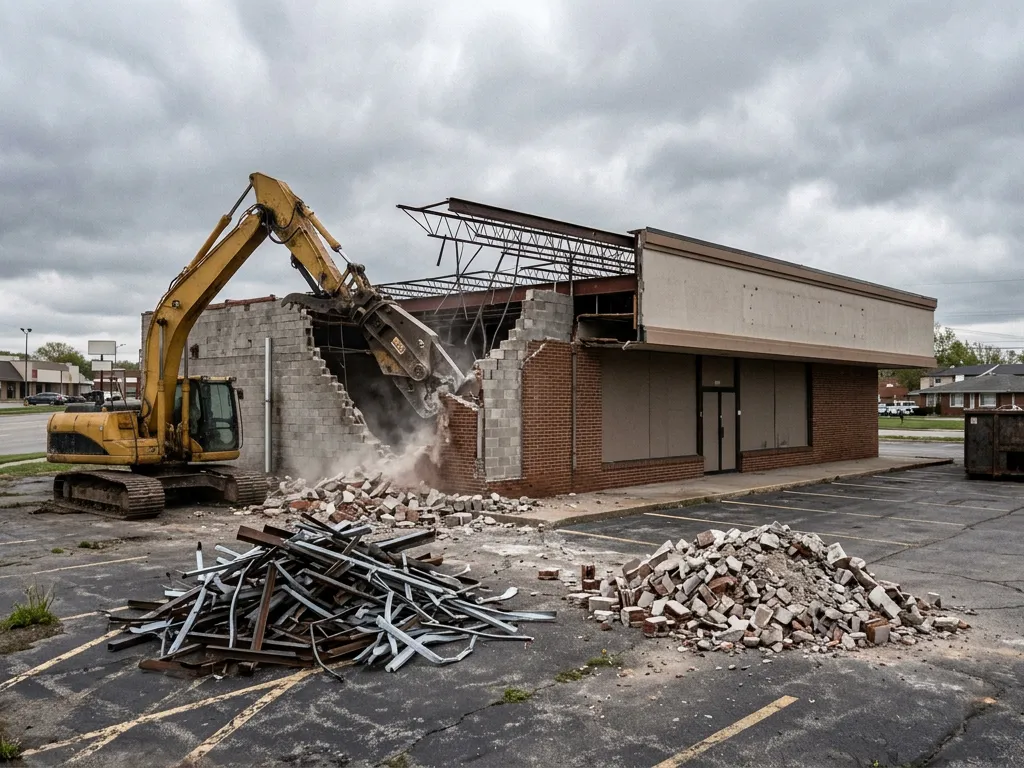
Stores, shops and small commercial buildings
Independence Demolition Pros: Commercial Demolition in Independence, Missouri
Vacant storefronts along Noland Road and US-24, block-and-brick shops, small warehouses and service stations, taken down with the asbestos notice filed, the slab out or left, and the pad graded for what comes next.
- Independence and 10 towns within 20 miles
- Written price before any work starts
- City permit, utility and asbestos steps explained
- Local, licensed, insured contractors
Independence Demolition Pros connects Independence property owners and developers with local contractors for commercial demolition of small and mid-size buildings: a closed restaurant on Noland Road, a block garage off US-24, a strip-center bay, a former gas station or a small warehouse. The crews we work with handle the asbestos survey and notice that commercial demolition always requires, the utility kills, the structural teardown and the pad.
Skipping the asbestos survey on a commercial building to save $2,000 to $5,000 is the one shortcut with a state penalty attached; Missouri requires the inspection and a ten-working-day notice for every commercial demolition, and a stop-work order with the roof half off costs more than the survey ever would.
What it costs
$8,000 to $40,000
Published guides put commercial demolition at $4 to $8 per square foot for buildings of 1,000 to 5,000 square feet (HelloData and CommLoan), so a 2,000 to 5,000 square foot building runs $8,000 to $40,000. Steel and masonry, a basement, asbestos abatement, underground tanks and a tight urban lot move the number, and larger buildings are quoted on their own.
Calls answered Monday to Friday 7 a.m. to 6 p.m., Saturday 8 a.m. to 2 p.m.
Commercial buildings that reach the teardown
- A storefront vacant long enough to draw a dangerous-building notice from the City
- A roof that has failed and let water into the structure for seasons
- A former gas station or shop with tanks and pits that a buyer wants gone before closing
- A redevelopment that needs a clear, graded pad rather than a renovated shell
- Fire or vehicle damage to a block building that an engineer has written off
Asbestos survey and notice, every time
Missouri's asbestos rules cover every commercial building. A Missouri-licensed asbestos inspector samples the roofing, floor tile, mastic, joint compound, pipe wrap, ceiling tile and any fireproofing; the lab results and the inspection report go with a Notification of Demolition on form MO 780-1923 to the Department of Natural Resources at least ten working days before demolition, whether or not anything is found. Inside Kansas City the notice goes to the City's own Air Quality Program. If regulated material above 160 square feet, 260 linear feet or 35 cubic feet is found, a registered abatement contractor removes it first. The asbestos page covers the thresholds.
- Survey
- Missouri-licensed inspector; report and lab results travel with the notice
- Notice
- MO 780-1923, 10 working days; Kansas City Air Quality Program inside KCMO
- Permit
- City of Independence demolition permit, $400 to $600 by square footage
Structure, slab and tanks
Block and brick buildings come down with an excavator and a shear or grapple, the steel sorted for scrap and the masonry crushed for recycling. Bar joists and metal deck roofs are cut and loaded. The slab usually comes out so the pad can be built on, and a former service station or repair shop is checked for underground storage tanks, hoists and oil pits, each with its own removal and disposal path. The quote names what was found on the walk-through and what happens if the ground holds more.
Building ready to come down for the next use?
Say what the building is, its square footage, whether it has a basement or tanks, and when it was built. A local contractor prices the survey, the teardown and the pad in writing.
Call (816) 846-2347Permits, utilities and the public right-of-way
Inside Independence the permit comes from Community Development at the commercial fee tier, with the same insurance certificate naming the City and the same utility verifications as a house. Commercial water services and sewer taps are larger and the kill at the main is inspected under a right-of-way permit from Municipal Services. Sidewalk and lane closures for a building on Noland Road or Truman Road are arranged with the City before the machine arrives. In Kansas City a Class I or Class II licensed demolition contractor pulls the permit.
Commercial demolition in the towns around Independence
The same work along the highway corridors in Blue Springs, Raytown and Grandview is permitted through each city's building office. A building torn down after a fire follows the fire-damaged demolition sequence, with the insurer's release first.
Commercial Demolition available in
Frequently asked questions
What owners ask before a teardown
How much does commercial demolition cost in Independence?
Published guides put small commercial buildings at $4 to $8 per square foot, so 2,000 to 5,000 square feet runs $8,000 to $40,000. Masonry, a basement, asbestos and tanks move it; larger buildings are quoted individually.
Is an asbestos inspection required for a commercial demolition in Missouri?
Yes, always. A Missouri-licensed inspector surveys the building, and the Department of Natural Resources receives a Notification of Demolition at least ten working days before the work, with the report attached, even when nothing is found.
What are the signs a commercial building should be demolished rather than renovated?
A failed roof that has soaked the structure, a dangerous-building notice, tanks and pits a buyer will not take, or a redevelopment plan that needs a clear pad.
What happens to the slab and the steel?
Steel is sorted and sold for scrap, masonry and concrete are crushed for recycling, and the slab usually comes out so the pad can be built on. Leaving the slab is an option when nothing is going on the spot.
Who handles street or sidewalk closures?
The contractor arranges them with the City before the machine arrives, along with the right-of-way permit that covers the water and sewer kills at the main.