
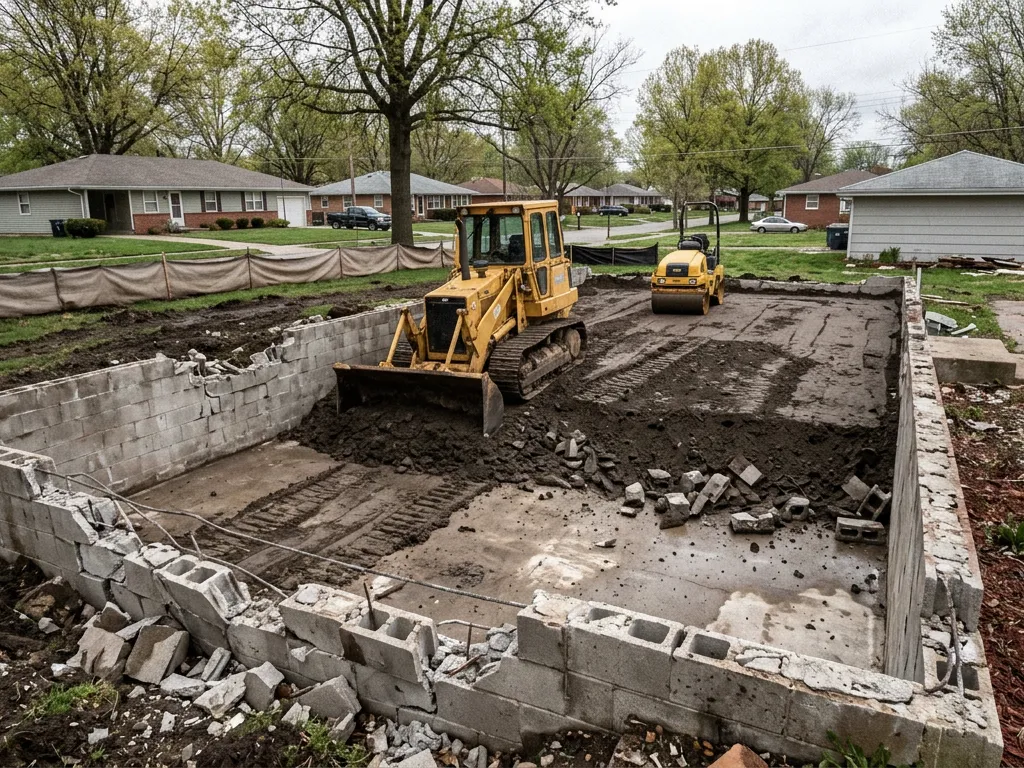
Walls, footings and slabs left behind
Independence Demolition Pros: Foundation Removal in Independence, Missouri
The block walls, poured footings and slabs that a long-gone house, garage or shed left in the ground, broken out, hauled to a recycler and the hole filled so the lot can be built on or mowed.
- Independence and 10 towns within 20 miles
- Written price before any work starts
- City permit, utility and asbestos steps explained
- Local, licensed, insured contractors
Independence Demolition Pros connects Independence owners with local contractors for foundation removal, the job that comes up when a house or garage was knocked down years ago and the walls and footings were left in the ground, or when a building comes down now and the lender, the buyer or the City wants nothing left below grade. The crews we work with break the concrete and block, pull the footings, sort the rubble for recycling, and fill and compact the hole.
Leaving an old foundation under a new lot saves $1,000 to $5,000 today and leaves a buried wall that the next builder's excavator finds on the first day, at which point removing it around new footings costs several times the price of taking it out on an empty lot.
What it costs
$1,000 to $5,000
The published national range for foundation removal (HomeAdvisor). A shallow garage slab with a turned-down edge sits near the bottom; a full basement of block or poured walls with footings sits near or above the top, and a basement fill-in is often the larger job. Clean concrete goes to a recycler, which holds the hauling cost down.
Calls answered Monday to Friday 7 a.m. to 6 p.m., Saturday 8 a.m. to 2 p.m.
Foundations that need to come out
- A vacant lot with the outline of an old house still showing as a sunken rectangle
- Block walls poking through the lawn where a garage or shed used to stand
- A buyer's or lender's survey that found a buried foundation on a lot sold as clear
- A new house, garage or addition planned over an old footprint
- A foundation cracked and heaved by the clay to the point that the structure above was lost
How a foundation comes out
An excavator with a hydraulic breaker or a bucket breaks poured walls and footings into liftable pieces; block walls come apart with the bucket. Rebar is cut and sorted for scrap, clean concrete goes to a recycler, and the soil is cut back far enough to reach the outside of the footing. Then the hole is filled with clean fill placed in lifts and compacted, crowned to drain, and seeded unless something is going to be built on it right away.
- Machine
- Excavator with breaker and bucket; skid steer for slabs
- Depth
- Footings out, or walls broken 18 inches or more below grade where a city allows it
- Fill
- Clean fill in lifts, compacted; engineered fill where a structure follows
Full removal or break-below-grade
Cities differ. Liberty's demolition bulletin requires floors, foundations, footings, basements and retaining walls removed to 18 inches below grade, with anything deeper broken to pieces no larger than eight inches. Independence does not publish a depth, so the quote follows what the lot is for: a lawn can live with walls broken well below grade and the slab cracked for drainage; a new building needs the footprint clear and the fill engineered. The contractor will ask which before pricing.
Old foundation in the way of a new plan?
Say what used to stand there, whether anything is being built on the spot, and whether a machine can reach it. A local contractor prices the removal and the fill in writing.
Call (816) 846-2347Unknown lots and old maps
A lot that has been vacant for decades may hold more than the foundation: a cistern, a coal chute, an old septic tank or a buried fuel tank are common finds under older Independence lots. Missouri One Call locates the live utilities, but the dead ones turn up with the bucket. A good quote carries an allowance for what the ground hides and says what happens if a tank is found.
Foundations in the towns around Independence
Liberty's 18-inch rule applies inside Liberty; Kansas City inspects the basement and sewer before the hole is filled. Where a whole building still stands on the foundation, the house demolition or garage demolition page is the place to start.
Foundation Removal available in
Frequently asked questions
What owners ask before a teardown
How much does foundation removal cost in Independence?
The published national range is $1,000 to $5,000. A shallow slab sits near the bottom; a full basement of block or poured walls sits near or above the top.
Does the whole foundation have to come out?
It depends on the city and on what follows. Liberty requires removal to 18 inches below grade. For a lawn, walls broken well below grade and a cracked slab are usually enough; for a new building the footprint must be clear.
What are the signs there is an old foundation under a lot?
A sunken or raised rectangle in the lawn, block showing at the surface, a survey note, or an old aerial photograph showing a building where there is none now.
What happens if a tank or cistern turns up?
Work stops at that spot. A cistern is pumped and filled; a fuel tank has its own removal and disposal steps, and in Lee's Summit the Fire Department is called before an underground fuel tank comes out. The quote should carry an allowance for it.
Where does the broken concrete go?
To a concrete recycler for crushing into road base, with the rebar sorted for scrap. That keeps the disposal cost well under the landfill rate.